The Computation
What is actually running, and why.
The central analytic result of the theory — α = log(5/2) — was derived by computing the second Weingarten moment η2 = 2/5 exactly. That required summing over permutations in S2: four terms, done by hand.
Higher moments require summing over larger permutation groups. The sixth moment η12 requires summing over S12, which has 479,001,600 permutations. That is not done by hand.
Why η12 matters
The theory currently has five exact moments: η2 through η10. These give five free cumulants of the Bell-sector amplitude distribution. If the sixth cumulant κ6 (which requires η12) follows the pattern suggested by the first five, it may reveal a closed-form recursion for the entire moment sequence — which would allow the fluctuation exponent β to be computed exactly rather than bounded.
It would also complete the picture of whether c(V) follows a compound free Poisson distribution, a result with significant implications for the structure of the cascade.
The η10 computation script
Below is a screenshot of the production script for η10 — the fifth exact moment, computed via Weingarten contraction over S10 (3,628,800 permutations). This is the same algorithm now being applied at the S12 scale.
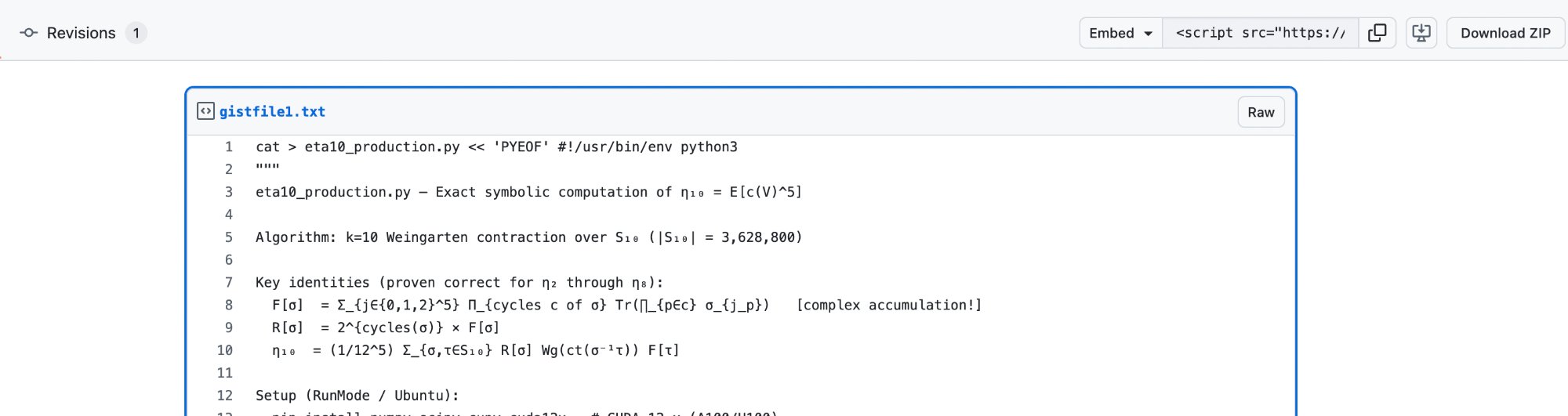
The η10 computation script. Key identities: F[σ] is the Bell-sector cycle trace product; R[σ] = 2cycles(σ) × F[σ]; η10 = (1/125) Σ R[σ] Wg(ct(σ−1τ)) F[τ].
The η12 enumeration: Phase 1
Phase 1 enumerates all 479,001,600 permutations in S12 and filters for those with nonzero F values. The computation runs in batches of 5,000,000. Below are two screenshots from the enumeration run.
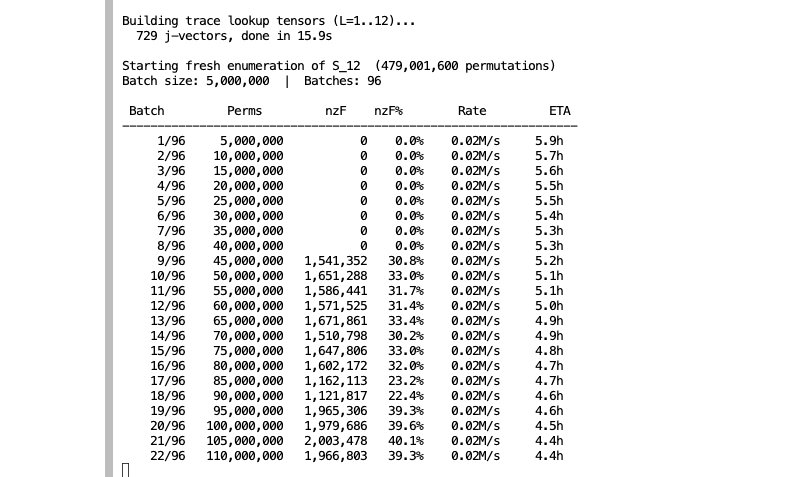
Batches 1–22 of 96. The first 40 million permutations yield zero nonzero F values — consistent with the Support Theorem: the sparse permutations with F ≠ 0 are concentrated in specific cycle types. At batch 10 (50M permutations), nonzero entries begin appearing at ~30% density.
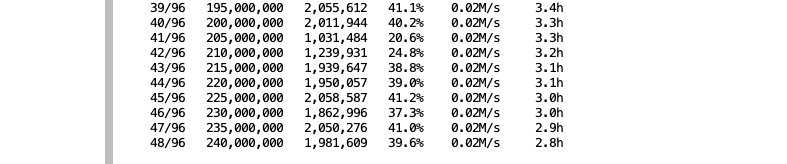
Batches 39–48 (195–240 million permutations). Rate holds steady at 0.02M/s. nzF% fluctuates between 20–42% across batches, reflecting the uneven density of admissible cycle types through the permutation ordering. Final count: 153,929,113 nonzero entries out of 479,001,600 total (32.14%).
What comes next
Phase 2 loads the 153 million nonzero F values and performs the Weingarten contraction — multiplying each pair by the appropriate Weingarten function value and summing. This is the step that produces η12 as an exact rational number. It requires CRT arithmetic (Chinese Remainder Theorem) because the intermediate values overflow both float64 and int64.
Estimated completion: before July 2026, subject to GPU availability.
All code is on GitHub.